India stands at the cusp of a transportation revolution. As city streets buzz with the quiet hum of electric scooters and the air grows cleaner with each passing day, the dream of sustainable urban mobility is gradually becoming reality. The Indian two-wheeler electric vehicle market is experiencing unprecedented growth, but this transformation hinges on a critical factor: the availability and accessibility of charging infrastructure.
The Electric Two-Wheeler Surge
The numbers tell a compelling story. Electric two-wheelers have moved from being a novelty to a practical choice for millions of Indians. With rising fuel prices, increasing environmental awareness, and attractive government subsidies, consumers are making the switch faster than ever anticipated. Cities like Bangalore, Delhi, and Pune are witnessing a surge in electric scooter sales, with manufacturers like Ola Electric, Ather Energy, TVS, and Bajaj leading the charge.
Making this transition even more accessible, numerous financial institutions now offer affordable two-wheeler financing options with interest rates starting as low as 6.2% per annum. In fact, 75% of two-wheeler purchases in India are funded through loans, making EVs financially viable for a broader segment of the population.
But as any EV owner will tell you, the convenience of electric mobility is only as good as the charging network that supports it. Unlike traditional petrol pumps that dot every street corner, charging stations for two-wheelers are still finding their footing in the Indian landscape.
Understanding the Charging Landscape
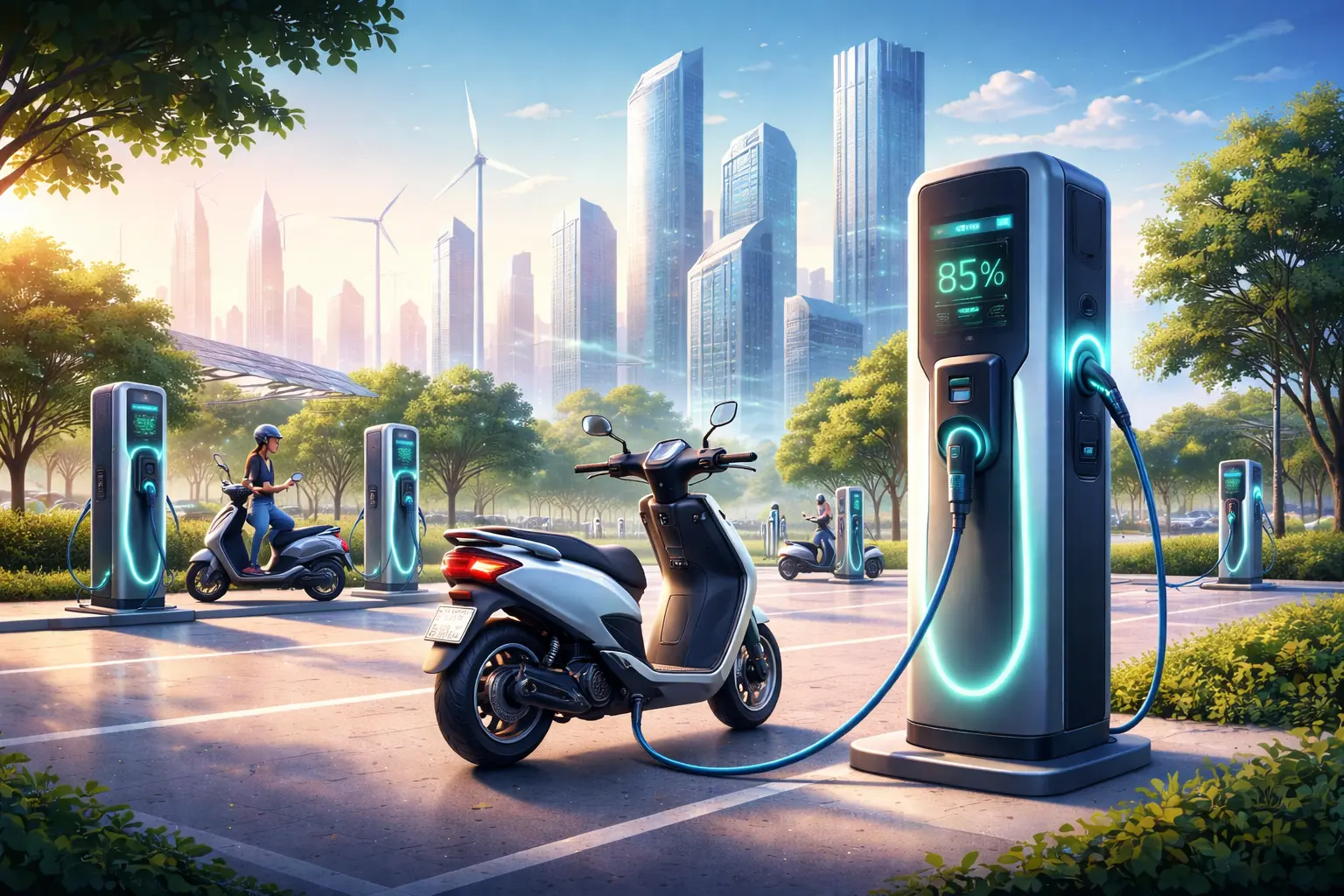
The charging infrastructure for two-wheeler EVs in India is evolving across multiple dimensions. Home charging remains the most common solution, with most electric scooter owners relying on standard household electrical outlets to charge their vehicles overnight. This works well for daily commutes within city limits, where the typical range of 80-150 kilometers per charge suffices for most users.
However, the real game-changer lies in public charging infrastructure. Battery swapping stations have emerged as an innovative solution, particularly for commercial fleet operators like delivery services and ride-sharing platforms. Companies like Sun Mobility and Battery Smart are pioneering this space, allowing riders to exchange depleted batteries for fully charged ones in under two minutes. This addresses one of the biggest concerns about EV adoption: charging time.
Fast-charging stations are another critical component. While home charging can take 4-6 hours, fast chargers can replenish batteries to 80% capacity in under an hour. These stations are strategically being deployed at shopping malls, office complexes, and along major highways, making long-distance travel on electric two-wheelers increasingly feasible.
State-Wise Charging Station Distribution: Who’s Leading the Charge?
India’s charging infrastructure has grown to 29,277 public charging stations as of November 2025 India Data Map, representing a remarkable expansion from just 6,586 stations in March 2023. However, this growth is not uniform across the country. Here’s a detailed breakdown of the current charging infrastructure landscape:
Top Performing States
Karnataka – 5,880 Stations Karnataka leads with 5,765 stations, accounting for 23% of the national total International Council on Clean Transportation. Bangalore has emerged as the EV capital of India, with aggressive policies mandating one charging point every 3 kilometers in the city. The state’s focus on the Bangalore-Mysuru highway corridor and strong public-private partnerships with companies like Tata Power and Statiq have created a robust ecosystem for EV owners.
Maharashtra – 3,728-3,746 Stations Maharashtra’s infrastructure is concentrated primarily along the Mumbai-Pune corridor, supporting the dense urban population and heavy traffic. The state’s policy of eliminating road taxes for EVs and mandating charging infrastructure in new constructions has resulted in approximately 1,000 new installations monthly.
Delhi – 1,886 Stations The national capital has implemented one of India’s most ambitious policies, requiring one charging point within every 3-kilometer grid. Delhi’s target of 18,000 stations by 2025 demonstrates its commitment to becoming a model EV city.
Uttar Pradesh – 1,989 Stations Despite being India’s most populous state, UP is rapidly expanding its charging network, particularly along national highways connecting major cities like Lucknow, Kanpur, and Noida.
Tamil Nadu Tamil Nadu rounds out the top five, with significant installations in Chennai and other major urban centers, supporting its growing EV manufacturing base.
Emerging States
- Gujarat: Strong industrial base driving commercial EV adoption
- Rajasthan: Focus on highway connectivity and tourist routes
- Telangana: Hyderabad leading urban charging infrastructure
- Kerala: Tourism-focused charging network development
States Needing More Support
Several states and union territories still have minimal charging infrastructure:
- Sikkim: 11 stations
- Mizoram: 13 stations
- Andaman & Nicobar: 4 stations
Geographic isolation and smaller vehicle populations in these regions present unique challenges, but expansion plans under FAME-II are underway.
Explosive Growth: The Charging Infrastructure Expansion Story
The expansion of charging infrastructure in India has been nothing short of remarkable. The numbers tell a powerful story of acceleration:
Growth Timeline
- March 2023: 6,586 public charging stations
- February 2024: 12,146 stations (84% increase)
- December 2024: 25,202 stations (107% increase from Feb 2024)
- November 2025: 29,277 stations (16% increase in 11 months)
This represents a staggering 345% growth in just under three years, with the pace of installation accelerating significantly in 2024-2025.
Future Projections and Targets
National Ambitious Goals The Indian government has set a target of establishing 1.32 million charging stations by 2030, with 22% allocated specifically for highway installations. This would mean nearly 45 times the current infrastructure within the next five years.
State-Level Commitments
- Delhi: 18,000 stations by 2025
- Karnataka: Additional 2,500 stations by 2025, beyond current numbers
- Maharashtra: 2,000+ stations focused on the Mumbai-Pune-Nashik triangle
Industry Expansion Plans Major charging network operators are scaling aggressively:
- Tata Power: Targeting 100,000 chargers by 2027, including 10,000+ DC fast chargers
- Zeon Charging: Expanding coverage across 15,000+ stations in 25 states
- Statiq: Managing real-time updates for 12,000+ chargers nationwide
Investment Momentum
Private investments exceeding Rs 10,000 crore are flowing into charging infrastructure India Data Map, with companies like Adani Electricity deploying 500 fast chargers incorporating solar energy. The PM E-DRIVE scheme has allocated ₹2,000 crore specifically for public charging stations, ensuring sustained growth momentum.
The EV-to-Charger Ratio Challenge
Currently, India maintains an EV-to-charger ratio of approximately 1:235, which is significantly higher than the ideal ratio of 1:20 to 1:150 recommended by experts. With 1.9 million EVs on Indian roads and annual sales reaching 1.9 lakh units, infrastructure development must accelerate to match the pace of vehicle adoption.
The Challenge of Scale
Despite the momentum, significant challenges remain. The charging infrastructure in India is still fragmented, with different manufacturers often using proprietary charging standards. This lack of standardization means that an Ather scooter owner might not be able to use a charging station meant for TVS or Ola vehicles, creating unnecessary complexity for consumers.
The geographical spread of charging stations is another concern. Only 20 percent of charging stations are located outside urban centers India Data Map, limiting the appeal of electric two-wheelers beyond metropolitan areas. For EVs to truly democratize transportation, charging infrastructure must reach every corner of the country.
The cost of setting up charging infrastructure also presents hurdles. While the government offers incentives, private players need clearer revenue models and faster approvals to justify their investments. Power grid reliability and capacity in many areas need upgrades to support large-scale EV charging without causing blackouts or voltage fluctuations.
Government Initiatives Paving the Way
The Indian government has recognized that robust charging infrastructure is non-negotiable for EV adoption. The FAME II (Faster Adoption and Manufacturing of Electric Vehicles) scheme allocates substantial funds specifically for charging infrastructure development. The newly launched PM E-DRIVE scheme in October 2024, with a total outlay of ₹10,900 crore, further reinforces this commitment with ₹2,000 crore dedicated to public charging stations.
State governments are also stepping up with their own policies. Delhi has mandated that one charging point must be available within every three-kilometer grid. Maharashtra offers incentives for private entities to set up charging stations. Kerala is working on a comprehensive EV policy that includes widespread charging infrastructure along tourist routes and in commercial centers.
The Ministry of Power has issued guidelines making it easier to set up charging stations, removing many bureaucratic hurdles. The emphasis on open standards and interoperability is gradually addressing the fragmentation issue, ensuring that all electric two-wheelers can use any public charging station regardless of brand.
The Three-Wheeler Revolution: Charging for Commercial EVs
While two-wheeler EVs are transforming personal mobility, electric three-wheelers are revolutionizing commercial transportation. Electric auto-rickshaws and cargo vehicles are increasingly becoming the backbone of urban logistics and passenger transport, with three-wheelers accounting for 35% of total EV sales International Council on Clean Transportation in India.
The charging infrastructure for three-wheelers follows a slightly different model due to their commercial nature and higher usage patterns. These vehicles typically require more robust fast-charging solutions and are increasingly benefiting from dedicated fleet charging stations. Companies like Mahindra Finance and specialized EV financiers like Risewise are offering tailored financing solutions for electric three-wheelers, with loan amounts of up to 90% of the vehicle cost and repayment tenures extending to 4 years.
What’s particularly encouraging is the emergence of innovative financing models specifically designed for auto-rickshaw drivers and fleet operators. Organizations like Three Wheels United are combining vehicle financing with charging infrastructure access, creating a comprehensive ecosystem that addresses both vehicle purchase and operational concerns. These solutions are critical because three-wheeler drivers often lack formal financial histories, making traditional lending challenging.
The government’s PM E-DRIVE scheme has allocated ₹4,391 crore specifically for electric buses and includes provisions for three-wheeler charging infrastructure, recognizing their crucial role in sustainable urban mobility.
Innovation Driving the Future
The future of two-wheeler EV charging in India looks remarkably promising, driven by technological innovation and creative business models. Smart charging solutions are emerging that allow users to locate nearby charging stations through mobile apps, check real-time availability, and even reserve slots. These apps also facilitate cashless payments and provide estimates of charging time based on current battery levels.
Solar-powered charging stations are gaining traction, particularly in areas with unreliable grid connectivity. These sustainable solutions not only reduce the carbon footprint of electric mobility but also make charging infrastructure viable in remote locations. Some companies are experimenting with portable charging solutions that can be deployed quickly in high-demand areas during festivals or events.
Wireless charging technology, though still in early stages, holds tremendous potential. Imagine parking your electric scooter over a charging pad at your workplace or a café, and having it charge automatically without any cables. While this remains futuristic for widespread adoption, pilot projects are already underway in select locations.
The integration of artificial intelligence and data analytics is optimizing charging networks. Predictive algorithms can anticipate demand patterns, suggest optimal locations for new charging stations, and even adjust charging speeds based on grid load, ensuring efficient use of electrical infrastructure.
The Road Ahead
For India to realize its ambitious goal of 80% electric two-wheeler sales by 2030, charging infrastructure must scale exponentially. This requires coordinated efforts from government bodies, private companies, real estate developers, and residential societies. Every parking lot, every apartment complex, and every commercial establishment should ideally have charging facilities.
The business case for charging infrastructure is strengthening. As EV adoption grows, charging stations will become profitable ventures, attracting more private investment. Partnerships between energy companies, automotive manufacturers, and tech firms are creating comprehensive ecosystems that address everything from charging hardware to software platforms and maintenance services.
Consumer education also plays a vital role. Many potential EV buyers still harbor range anxiety and charging concerns. Demonstrating that charging infrastructure is reliable, accessible, and continuously expanding will be crucial for mass adoption. The availability of easy financing options through various two-wheeler loan providers makes the transition to electric mobility more financially accessible than ever before.
Frequently Asked Questions (FAQs)
- How many EV charging stations are currently operational in India?
As of November 2025, India has approximately 29,277 public EV charging stations operational across all states and union territories, showing tremendous growth from just 6,586 stations in March 2023. Karnataka leads with 5,880 stations, followed by Maharashtra with 3,746 stations and Delhi with 1,886 stations. The government aims to reach 1.32 million charging stations by 2030.
- How long does it take to charge an electric two-wheeler?
Charging time depends on the method you choose. Home charging using a regular household socket typically takes 4-6 hours for a full charge, which is perfect for overnight charging. Fast charging stations at public locations can charge your battery to 50-80% in just 45-60 minutes. For those who need instant solutions, battery swapping stations allow you to exchange your depleted battery for a fully charged one in under 2 minutes.
- What is the cost of charging an electric two-wheeler at public stations?
Public charging costs in India are highly economical. Slow AC charging typically costs between ₹2.50-3.50 per unit of electricity, while DC fast charging ranges from ₹10-12 per unit. For most electric scooters, a full charge costs between ₹15-40, which is significantly cheaper than the ₹80-120 you would spend on equivalent petrol. This makes electric two-wheelers not just environmentally friendly but also economically smart for daily commutes.
Conclusion
The future of mobility in India is undeniably electric, and two-wheelers will lead this transformation. Charging infrastructure is not just an enabler of this future; it is the foundation upon which the entire electric mobility ecosystem stands. With nearly 30,000 charging stations operational today and ambitious plans to reach over a million by 2030, India is building the backbone of sustainable transportation.
The exponential growth from 6,586 stations in 2023 to 29,277 in 2025 demonstrates that the momentum is real and accelerating. As charging stations become as ubiquitous as petrol pumps, as battery swapping becomes as quick as refueling, and as home charging becomes standard in every household, the barriers to EV adoption will crumble.
Financial accessibility is also improving rapidly, with numerous banks and NBFCs offering competitive loan products for both two-wheelers and three-wheelers, ensuring that the electric revolution is inclusive and reaches every segment of society.
The journey has just begun, but the destination is clear: a cleaner, quieter, and more sustainable India where electric two-wheelers are the norm rather than the exception. The charging stations being built today are not just powering vehicles; they are powering a revolution in how a billion people move, live, and breathe. And that future is closer than we think.